

Some branded products get photographed. Most get left on a table.
The difference has nothing to do with how much you spent. It has everything to do with whether the person who received it did something to get it. A brand activation is the moment where your audience stops being a recipient and starts being a participant. That shift is small in execution and enormous in impact.
Here’s what that actually means, and how to build it into your next campaign.
What Is a Brand Activation?
A brand activation is any campaign or experience designed to trigger active participation with your brand. Attendees don’t just receive something. They do something.
That distinction matters more than most marketing budgets reflect. Research from Reach3 Insights and The Keller Advisory Group found that 55% of consumers report feeling an emotional connection to a brand through experiences, compared to 16% who say the same about traditional advertising.
Our Experience-in-a-Box campaigns are built around this exact mechanic!
The one-off promo product has its place. A well-chosen pen or a quality tumbler keeps your brand in someone’s hand daily. But a brand activation creates a memory. And memories drive referrals, repeat orders, and the kind of brand equity that doesn’t show up in a single campaign report.
Types of Brand Activations
Brand activations aren’t one format. They’re a mechanic that can run through almost any campaign structure. Four categories cover most of what you’ll see in B2B:
1. Experiential / Event Activations
These events create live, in-person moments where the product is part of the experience itself. For example, kitting stations at conferences, on-site assembly bars, or interactive giveaways where the guest gets to make a choice.
For these kinds of activations, the physical presence of the brand moment is the point.
2. Product Sampling + Interactive Gifting
This includes any physical product that requires some kind of engagement to receive or unlock. This includes curated unboxing sequences, personalized selections, mystery kits that reveal on a specific date.
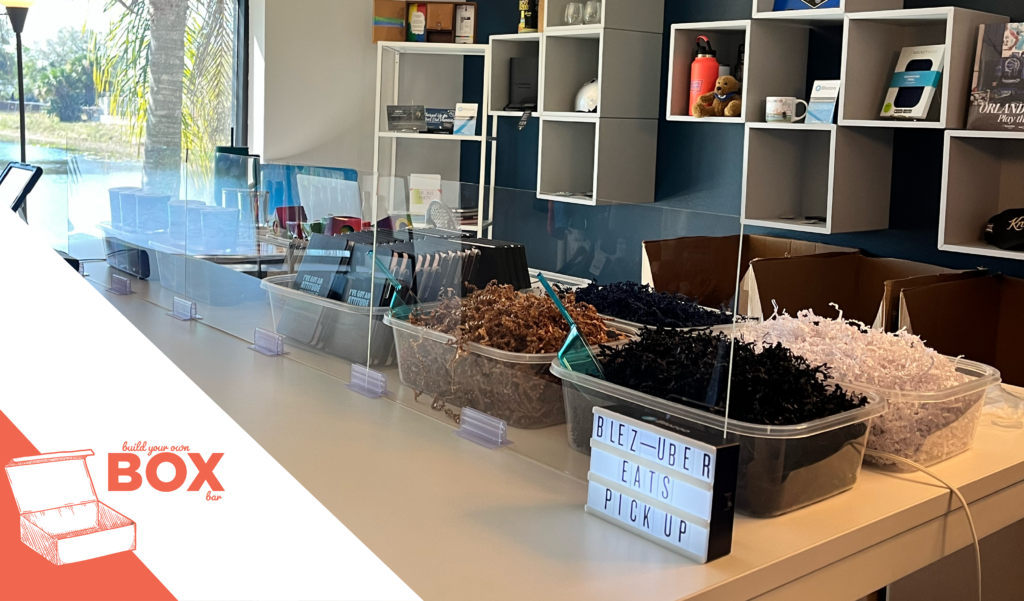
We did this at Blezoo for one of our own in-house events and it was a hit! Brands use this kind of activation to create product anticipation.
3. Pop-Up and Retail Activations
These are temporary branded environments built around a specific product or campaign moment. Limited-edition drops, personalization stations, co-branded builds.
The secret ingredient for this kind of campaign is the urgency. The “temporary” framing creates urgency that permanent retail just can’t generate!
4. “Phygital” Activations
This is one of the most underrated activation types! Here, the physical product acts as the on-ramp to a longer digital experience. A PPAI research study found that nearly half of consumers preferred promo products that connected to digital content or apps.
A QR code that unlocks exclusive content on scan, an NFC chip that triggers a campaign page, a branded item paired with a social challenge.
The possibilities are endless!
Brand Activation Ideas (and How Interactivity Changes the Campaign)
Most campaign formats have a passive and an active version. The passive version tends to be forgotten. Here’s what an upgrade could look like for your brand:
1. Product Launch
The default: a branded swag bag mailed to target accounts ahead of the announcement.
With an activation mechanic: a teaser kit with no logo. Select products that hint at the campaign without revealing it and let the recipients decode the brand on reveal day. The product becomes a puzzle, and your audience is engaged before you’ve said a word!
2. Employee Onboarding
The default: a pre-packed welcome box shipped to the new hire’s address.
With an activation mechanic: a “build your kit” step embedded in the onboarding flow. The new hire selects a color, a preference, a customization. Ownership starts before day one, and the box that arrives doesn’t feel like a form was filled out somewhere.
Already thinking about handling fulfillment for these kinds of orders? No problem, Blezoo handles these projects in our sleep! We’d be happy to walk you through the next steps – just reach out!
3. ABM / Sales Outreach
The default: a product drop, maybe including a handwritten note.
With an activation mechanic: a super targeted physical mailer where the product selection is clearly specific to the recipient’s industry, role, or company. The curation is the message and it signals that you paid attention.
4. Client Appreciation
The default: an end-of-year gift sent to accounts.
With an activation mechanic: a VIP experience kit where items map to something specific about the client’s year. A product that references a shared project milestone or something that nods to a campaign they ran. The selection becomes a conversation starter.
Sourcing the right products for these mechanics is the most important part. It’s what separates a campaign that converts into a memorable moment from one that doesn’t.
5. Trade Show / Conference
The default: a branded tote with a logo at the exit. But, everyone gets the same thing, so nobody remembers where it came from.
With an activation mechanic: a kitting station where attendees select from a curated product set. When they build something themselves, they carry it out differently. Check out how we did it at our own event!
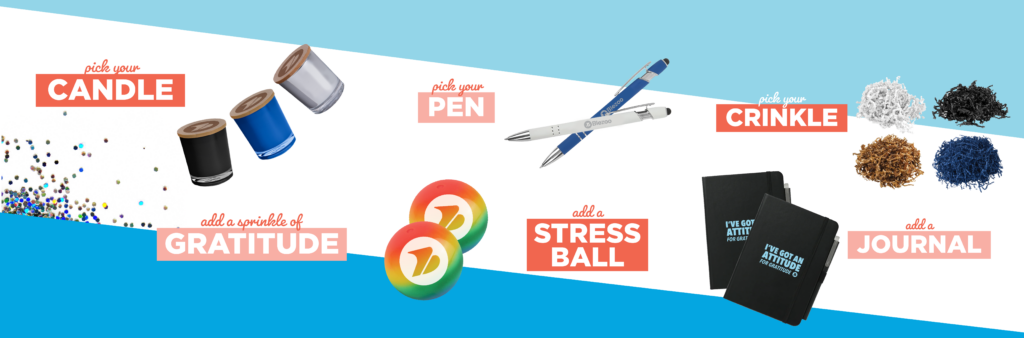
To make it easier on yourself, you can outsource these projects to a product partner like Blezoo. We take care of custom product curation, decoration and order fulfillment, so all you have to do is let us know who it’s for and we’ll start pulling high-quality items for you to match to your audience.
How to Plan a Brand Activation
Five steps, in order. Skip one and the execution suffers.
1. Define the Moment
What do you want someone to feel, do, or say after this experience? And get specific! “Build brand awareness” is not a moment, but “Leave the event with a product they chose and photographed” is.
2. Choose Your Format
Live event, direct mail, pop-up, or phygital? The format should match where your audience actually is and how much friction they’ll tolerate. A field sales team at a trade show is a completely different audience than a VP receiving a package at their desk.
3. Select Products With Purpose
Every product in the activation should do at least one of three things: drive participation in the moment, extend the experience after it ends, or serve as a lasting brand reminder. If a product doesn’t do any of those things, cut it.
4. Build the Brief
Timeline, quantities, delivery logistics, brand standards. This is where activations fall apart when skipped. A kitting bar with the wrong products because someone didn’t brief the vendor is worse than no activation at all.
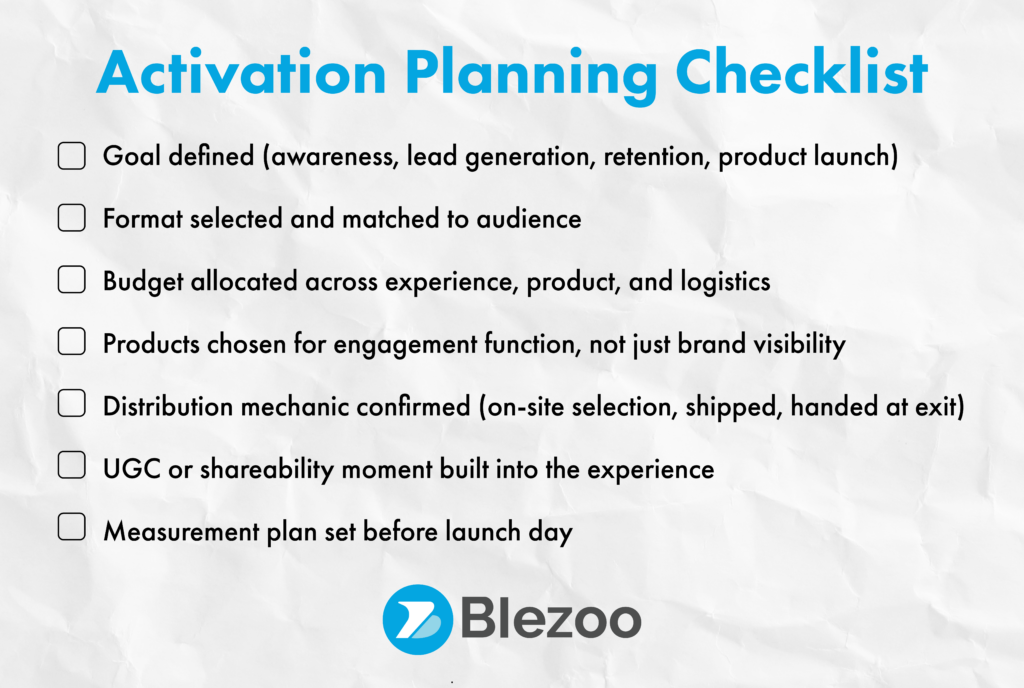
5. Set Your Metrics Before Launch
Define what success looks like before the activation runs. The section below gives you the framework.
Ready to Create Your Own Activation?
The brands being remembered aren’t necessarily the ones spending the most. They’re usually the ones giving their audience something to do.
Physical, curated, and participatory is the combination that converts a brand touchpoint into something people keep and talk about. Blezoo sources the products that make those moments happen, for any project type and any budget.